Should I Use Excel Sheets For Church Accounting?

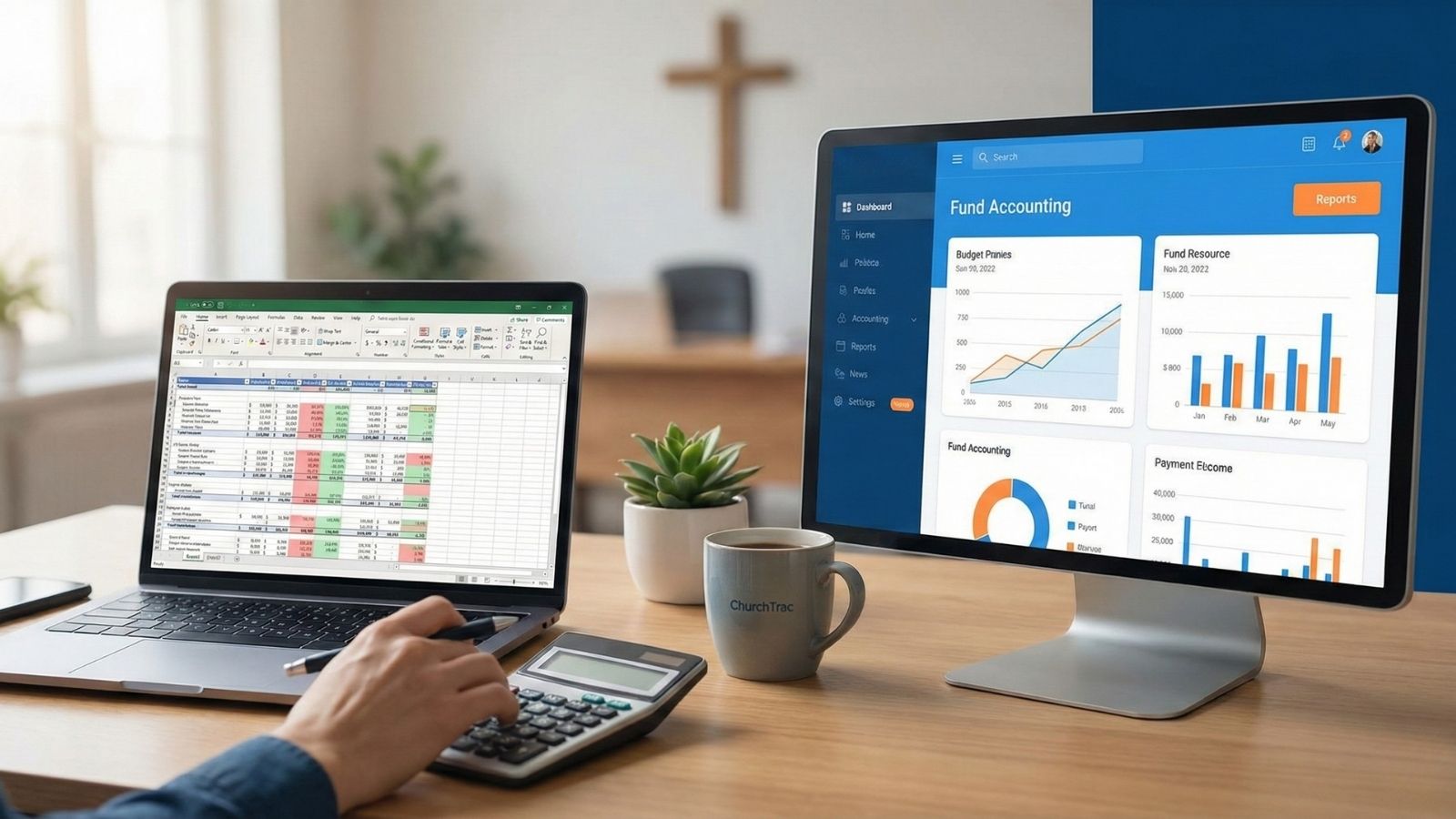
Most church treasurers don’t sign up to be accountants.
Many are volunteers with little formal accounting experience. They step in simply because someone has to manage the church’s finances.
That’s why many churches start with Excel. It’s familiar, accessible, and feels like a safe place to begin.
And for some churches, that’s perfectly fine (at least for a season).
The real question isn’t “Can we use Excel?” It’s whether Excel is still serving your church well as your financial responsibilities grow.
TL;DR: Excel can be a responsible starting point for small churches with simple finances. But as churches begin managing multiple funds, payroll, and recurring expenses, spreadsheets quickly become time-consuming and harder to maintain. Most churches eventually benefit from church accounting software, while still using Excel for viewing and sharing reports.
Why Excel Is Better Than Pen and Paper
Using Excel is already a step in the right direction. Compared to pen-and-paper systems, spreadsheets provide structure, visibility, and consistency (three essentials for responsible financial stewardship).
For small churches with one fund and one person managing finances, Excel offers basic organization and clarity. Ultimately, every church needs a financial system. Excel is often the first responsible step.
When Excel Still Works Well for Church Accounting
Excel works best when church finances are simple and centralized.
In general, Excel may work well for your church if:
- You have just one bank account.
- Your church primarily operates from one fund.
- You do not run payroll.
- You do not process staff reimbursements.
- Monthly expenses are predictable and consistent.
- Only one person manages the finances.
If your church fits this profile, Excel can be a reasonable and responsible choice (for now).
Where Excel Starts to Break Down
As churches grow, financial complexity grows with them. That’s where Excel often begins to show its limits.
Excel commonly stops working for a church's finances when the church begins to manage:
- Multiple designated funds (building, youth, missions, etc.).
- Recurring monthly expenses that require consistent tracking.
- Payroll/clergy wages, housing allowance, reimbursements.
- Budgets for multiple ministries.
- Monthly reconciliations and audit preparation.
- Shared access for multiple church leaders.
- Treasurer transitions.
Key insight: Excel doesn’t scale with complexity; it multiplies it.
The Hidden Cost of Using Excel for Church Accounting
Excel may appear inexpensive, but the real cost is rarely financial. As complexity increases, spreadsheets demand more manual entry, formula maintenance, and constant double-checking.
Over time, what started as a simple system becomes a source of stress and burnout (especially for volunteer treasurers).
Key idea: The issue isn’t cost: it’s time, risk, and sustainability.
Signs Your Church Has Outgrown Excel
Your church may be ready for accounting software if:
- Financial questions require digging through spreadsheets to find answers.
- Reports are constantly needing to be rebuilt.
- Multiple leaders need access to financial data.
- Tracking designated funds has become difficult.
- You need to track payroll and reimbursements.
- You are tracking multiple budgets.
- Your treasurer is overwhelmed.
These signs don’t indicate failure. They simply reflect a growing ministry with increasing responsibility. At this stage, many churches discover that accounting software doesn’t add complexity; it reduces it.
Using Church Accounting Software and Excel (The Reality)
Excel can still be useful, but as a tool, not the system.
Many churches continue using Excel for reports, planning, and presentations.
The difference is that accounting software becomes the central source of truth, reducing manual work and improving consistency.
This also makes leadership transitions far easier. New treasurers step into a system—not a maze of spreadsheets.
ChurchTrac Helps You Move Beyond Spreadsheets
ChurchTrac helps churches centralize financial records, simplify fund tracking, and generate clear reports without constant manual work.
Instead of forcing spreadsheets to do what they weren’t designed for, churches can use tools built specifically for transparency, accountability, and long-term stewardship.

The Question Churches Should Really Be Asking
So, should your church use Excel? A better question is whether Excel is still serving your church, or slowing it down.
Faithful stewardship requires clarity, accountability, and sustainability. The right system should support your ministry, not work against it.
Church Accounting FAQs: Excel vs Software
Is Excel acceptable for church accounting?
It can be for small churches with simple financial activity. Excel can be an acceptable and responsible starting point. It offers basic organization and visibility, especially when finances are limited to a single fund and managed by one person. The challenge arises when financial complexity increases and spreadsheets begin requiring excessive manual work to maintain accuracy.
At what size should a church move beyond Excel?
There isn’t a specific attendance number or budget threshold. Instead, churches often outgrow Excel when they begin managing multiple funds, running payroll or reimbursements, preparing regular reports for leadership, or sharing financial oversight among multiple people. When answering basic financial questions becomes time-consuming, it may be time to consider accounting software.
Can we still use Excel if we adopt accounting software?
Absolutely. Many churches continue to use Excel even after adopting accounting software. The difference is that Excel becomes a supporting tool—for reporting, planning, and presentations—while the accounting system serves as the central source of truth for financial data.
How do we transition without overwhelming volunteers?
The best transitions are gradual and well-communicated. Start by choosing software designed specifically for churches, migrate key financial data thoughtfully, and provide simple training for those involved. Most importantly, focus on reducing manual work rather than adding new complexity. The goal is to support volunteers, not burden them.
Financial Disclaimer: This article is provided for informational purposes only and does not constitute professional accounting, tax, or financial advice. Church tax laws are complex and subject to change based on federal, state, and denominational regulations. ChurchTrac is a software provider, not a CPA firm. We strongly recommend consulting with a qualified tax professional or certified public accountant before making financial decisions or filing tax-related documents for your ministry.