How Long Should a Church Keep Financial Records?

- This article breaks down exactly what financial records your church needs to keep, how long to keep them, and why it matters.
- You'll learn the difference between permanent records, seven-year documents, and short-term files, plus how federal and state laws apply.
- A sample retention schedule is included to help you get started.
How long should a church keep financial records? It’s a question every pastor, admin, or finance team eventually faces and one that can come back to bite you if you guess wrong.
You’re already juggling a hundred responsibilities. The last thing you want is to waste time keeping documents you don’t need… or worse, toss out something you were legally supposed to keep.
Potential Drawbacks or Considerations
Let’s clear that up right now. This guide will walk you through exactly what to keep, for how long, and what to do next.
Record Retention Requirements for Churches
Most churches don’t fall short because they don’t care. They fall short because nobody ever told them how high the bar actually is.
Here’s what’s at stake:
- Compliance: Churches must meet IRS and state requirements to maintain tax-exempt status.
- Transparency: Clear records help demonstrate financial stewardship to donors, board members, and auditors.
- Operational Efficiency: Accurate and well-kept records streamline budgeting, audits, and long-term planning and require less consulting.
Here’s what you need to know upfront:
- The IRS expects you to keep any records that support your income, expenses, deductions, and payroll reporting.
- State laws can (and often do) add more layers to this. Some states require churches to hold on to records for 10 years or longer.
So, unless you’re trying to memorize tax code... let’s make this easy.

Federal Requirements
The IRS requires all tax-exempt organizations to maintain documentation that supports their financial activity. According to the IRS, records must be kept “as long as they may be needed for the administration of any provision of the Internal Revenue Code.”
At a minimum, churches should retain:
- Documents that support income, deductions, and credits reported on any tax filings.
- Employment tax records for at least four years after the date the tax becomes due or is paid.
State-Specific Regulations
Retention rules can vary by state. For example, some states require nonprofit organizations to keep records for 10 years or more. Check with your state’s attorney general or department of revenue for guidelines specific to your location.
Pro Tip: Even if your state doesn't explicitly require it, longer retention can provide protection during disputes or audits.
So, how do you stay compliant with both state and federal guidelines without becoming a full-time file clerk?
Simple: Know what category each record falls into, and build your retention around that.

How Long to Keep Church Financial Records (Categorizing Your Records)
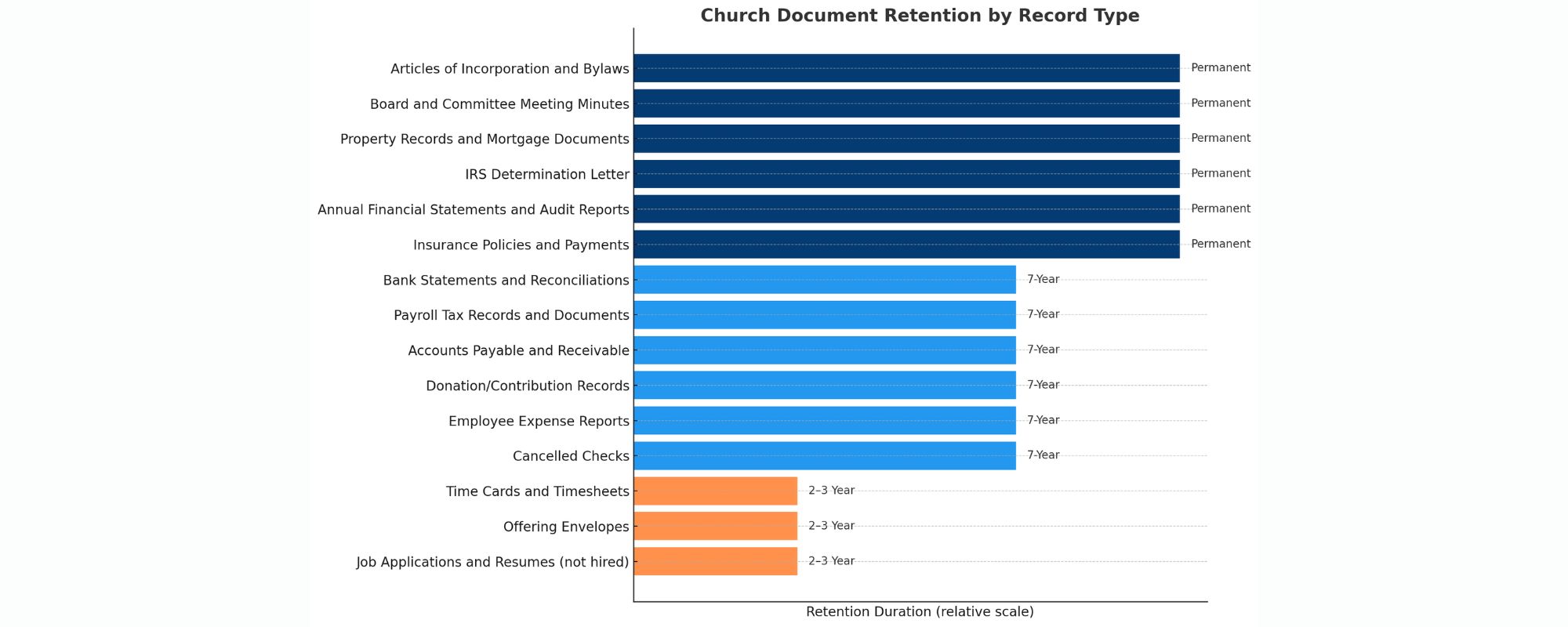
Let’s put your records into 3 buckets:
Throw-It-Out-Never (Permanent Church Records)
These are the “do not delete” items. These form the legal and financial backbone of your church:
- Articles of Incorporation and Bylaws
- Board and Committee Meeting Minutes
- Property Records and Mortgage Documents
- IRS Determination Letter (Tax-Exempt Status)
- Annual Financial Statements and Audit Reports
- Insurance Policies and Payments (for property, church staff compensation, etc.)
These are the documents that define your church’s identity. They need to be kept permanently, period.
The Seven-Year Stretch (Seven-Year Retention)
Seven years feels like a long time… until you get audited. These are records the IRS or state could request during an audit:
- Bank Statements and Reconciliations
- Payroll Tax Records and supporting documents (W-2s, 1099s, Form 941)
- Accounts Payable and Receivable
- Donation/Contribution Records
- Employee Expense Reports (Payroll Deductions)
- Cancelled Checks
Why seven? Because the IRS can go back that far, and sometimes longer if fraud or errors are suspected.
Short-Term Retention (2–3 Years)
These items don’t need to stick around forever. These are often used for short-term tracking or operational needs:
- Time cards and Timesheets
- Offering Envelopes
- Job Applications and Resumes (if not hired)
Use them, reference them, then move on.
Best Practices for Record Management
Here’s the deal: Most churches aren’t noncompliant because they’re lazy. They’re noncompliant because nobody gave them a system.
So let’s fix that.
A written document retention policy protects your church, streamlines your workflow, and gives your staff crystal-clear direction.
If someone ever asks, “Why are we keeping this?” you’ve got your answer.
Develop a Document Retention Policy
Every church should have a clear policy that defines:
- What documents to retain
- How long to retain them
- How and when to dispose of them securely
Pro Tip: A retention period typically has a defined start date (when the record is created or becomes inactive) and an end date (when it can be destroyed or archived).
A formal policy protects your church legally and keeps everyone on the same page.
Use Digital Recordkeeping
Paper files are vulnerable. Fire, water damage, theft, misplacement, anything can happen.
Digital storage solves most of that. It also makes retrieval a whole lot faster when someone asks for “that report from 2019.”
Look into secure cloud-based tools or encrypted external backups. You’ll never go back.
Transitioning to digital storage has several benefits:
- Secure cloud-based, electronic backups
- Easier search and retrieval
- Protection against loss due to fire, flooding, or theft
Conduct Regular Reviews
Once a year, block off a morning to:
- Review your retention schedule
- Purge expired records securely
- Double-check that digital files are backed up
Pro Tip: Set a calendar reminder to review records annually.
Implementing a Retention Schedule
Smaller churches may need a more streamlined version, while larger churches should ensure compliance with both federal and state regulations. Always document any variations in your official retention policy.
Sample Church Financial Record Retention Schedule
View your Downloadable PDF HERE!
Customize the Schedule to Fit Your Church
Customize this list to your state’s requirements and make it part of your onboarding for finance volunteers and staff.
Consequences of Non-Compliance
We’re not here to scare you. But the risks are real. Failing to maintain proper financial records can have serious implications.
Legal & Financial Trouble
Lose key documents, and your church could:
- Loss of tax-exempt status
- Fines or penalties during IRS audits
- Inability to defend against financial disputes
Operational Disruptions
Without solid records:
- Difficulty in preparing budgets and reports
- Breakdown in donor confidence
- Compromised grant eligibility or fundraising transparency
It’s like driving with your eyes closed. Eventually, something’s going to crash.
Tools to Make Record Keeping Easier
Let’s be real, recordkeeping can get overwhelming fast. And not every church has an accountant on staff or a spare room for file cabinets.
So, what’s the move?
If you're looking for a tool that actually helps you manage your records without needing a degree in accounting or six different logins, there's one clear standout:
Recommended Software for Churches That Want to Simplify Their Church Records
If you’ve ever thought…
“This is too much.”
“I’m not a CPA.”
“I don’t want to juggle five apps.”
Why ChurchTrac?
- Church-specific accounting tools
- Document storage without needing a Dropbox or a filing cabinet
- Giving history, membership, and reporting, all in one place
- A user-friendly interface that your whole team can actually use
Whether you’re a full-time administrator or a volunteer bookkeeper, ChurchTrac makes it doable.
Further Reading on Church Record-Keeping
- IRS Publication 557 – Tax-Exempt Status for Your Organization
- National Council of Nonprofits – Document Retention Policy
Final Thoughts on Financial Record Stewardship (And Your Next Steps)
Let’s not sugarcoat it: If you don’t have a system, it’s not a matter of if it catches up to you. It’s when.
But here's the good news:
- You don’t need to panic.
- You don’t need a finance degree.
- You don’t need to go it alone.
Take Action Today:
- Review your current process
- Draft or revise your retention policy
- Go digital, where you can
- Bookmark this page for next year’s audit prep
Above all, use tools that actually help. Because your time is too valuable. Your mission is too important. And your church deserves better than “I thought we didn’t need that anymore.”
FAQs
Do churches need to keep paper copies, or are digital records okay?
Digital records are perfectly acceptable, as long as they are accurate, accessible, and securely stored. The IRS does not require paper copies if digital files meet the same standard of integrity.
Can we scan and then destroy the original paper records?
Yes, for most documents. As long as the scanned versions are complete, legible, and securely stored, originals can typically be destroyed, but always check state-specific laws and consult a legal or accounting professional for sensitive records like legal documents or signed contracts.
What happens if a church loses old financial records?
If you're missing records that should have been retained, you may face issues during an audit, including fines, loss of tax-exempt status, or inability to prove key financial decisions. It's best to start documenting everything now and create a system moving forward.
How often should churches review their record retention policy?
Annually. Set a calendar reminder for a quick yearly review to ensure your policy is up to date, expired records are purged, and digital files are backed up.
What if we’re a small church without a formal policy yet?
Start small. Use the sample retention schedule in this guide and customize it to your state’s laws. Even a simple spreadsheet outlining what to keep (and for how long) is better than nothing.
Can we use ChurchTrac to manage document storage and retention?
Yes! ChurchTrac includes secure document storage, giving and contribution records, and financial reporting, all in one place. It’s a great way to centralize your church’s data and reduce reliance on paper or multiple systems.
How long should we keep offering envelopes?
Offering envelopes typically only need to be retained for 2–3 years, as they are used for short-term tracking and internal verification. Contribution statements or digital giving records are more critical and should be retained for 7 years.
Do we need to keep cancelled checks if we have bank statements?
Yes. Cancelled checks should be kept for 7 years, especially those related to donations, payroll, or large expenditures. They often provide key documentation in audits.
What about records from volunteers or temporary staff?
Resumes, applications, and background checks for individuals not hired should be kept for at least 2 years. For those who are hired, include their documentation in your permanent personnel file retention plan (usually 7 years after termination).
Learn how ChurchTrac can help simplify your financial records.