Best Church Management Software Picks (2026)

- Rock RMS: Open-source powerhouse with deep customization.
- Planning Center: The popular modular choice for premium ministry apps.
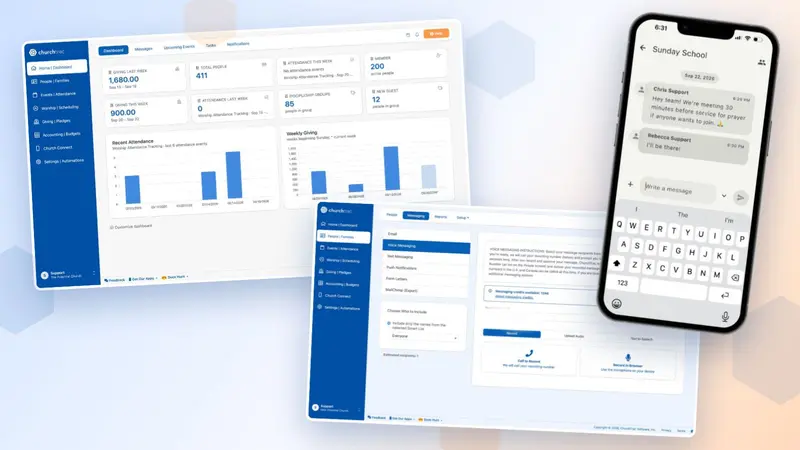
- ChurchTrac: Best all-in-one value for churches under 2,000 members.

Jump to a Section:
Finding the best church management software for your ministry is daunting. Most online guides overwhelm you with a bloated list of 20 random options ranked by who pays the highest affiliate commission.
We aren't doing that.
Full disclosure: We build ChurchTrac. We're incredibly proud of our platform, but we aren't going to pretend we're a perfect fit for a 10,000-member megachurch.
Instead of wasting your time, we've narrowed the entire landscape down to three distinct software ecosystems worth considering: open source software, modular software, and all-in-one software.
Unlike other review sites that spout off AI generated content... I've used all three of these platforms extensively for years. Here is the unvarnished truth about how they stack up.
Rock RMS
Best for: Large churches with dedicated IT resources
Rock RMS is a non-profit open source church software that currently powers 10 of the 12 largest churches in the nation. Rock RMS is highly customizable and one of the most powerful platforms available.
Rock RMS is best for: Larger churches with the right tech resources or a dedicated IT person.
Rock RMS is not a good fit for: Small and mid-size churches that do not have a dedicated tech person.
Pros
- ✓ Open-source and fully customizable church software
- ✓ Strong community of developers and ministry leaders
- ✓ Packed with features and fully open for integrations
Cons
- ✕ Requires development skills in-house or from a trusted partner
- ✕ Churches under 1,000 members may find it complete overkill
- ✕ Yearly costs often exceed most other ChMS providers
Top Rock RMS Features
Rock RMS has dozens of features. Here are the top 5 most churches care about:
| Church Management | Including people management and events |
| Communication | Ability to send mass emails and SMS |
| Church Website | Built-in website builder |
| Church Apps | Mobile church app and other media |
| Engagement | Groups, scheduling, and next steps |
Rock RMS Pricing
Since Rock RMS is a non-profit, they do not charge for their software in the conventional sense. Instead, Rock RMS asks for a donation of $4.45 per weekly attendee (every year).
| Church Size | Average Monthly Cost |
| Small Church (under 200 members) | ~$50 |
| Mid-Size Church (200–1,000 members) | $74 to $370 |
| Large Church (Over 1,000 members) | $370+ |
My Experience with Rock RMS
My current church (about 2,000 attendees) uses Rock RMS. Our church heavily leverages the database, check-in, and the mobile app. That being said, we still leverage different platforms for things like our website, newsletter, and worship planning. Rock's service planning isn't as robust as Planning Center or ChurchTrac.
As a member, I find their mobile app to be similar in comparison to other apps like Subsplash or Church Connect®. Their check-in system is the fastest I've ever used. As a parent, I can check in my kids and print out their labels in a few seconds. The printers are not cheap though.
As an industry insider who travels to many conferences, I've spoken with multiple leaders at some of the largest churches in the world that use Rock RMS. Here are two observations from those conversations:
- Many churches don't "donate" the recommended amount to Rock RMS.
- A significant number of churches are outsourcing their Rock RMS development for tens of thousands of dollars per year. Multiple leaders told me... "It's over my head."
Open Source Runner Up: ChurchCRM
ChurchCRM is similar to Rock RMS in terms of features and functionality. I've personally found its UI to be basic like many other open source CMS tools I've used in the past. For mid-size churches looking for a true open source platform with no "donation strings" attached, ChurchCRM would be worth looking into.
Planning Center
Best for: Churches needing specialized ministry apps with larger budgets
Go to almost any ministry circle, and you'll find worship teams using Services and children's ministries using the Check-Ins app. Planning Center's apps are incredibly popular across ministries of all sizes, and for good reason — they're good! Because they allow you to try modules for free, there is a low barrier to entry for any ministry looking to level up their weekend operations.
Planning Center is best for: Churches looking for a couple of specialized tools (like worship planning), or larger churches with the budget to invest heavily in a premium, fully integrated app ecosystem.
Planning Center is not a good fit for: Churches on a budget or ministries looking for an all-in-one church platform.
Pros
- ✓ The "Gold Standard" for churches needing specific ministry apps
- ✓ Fast and knowledgeable customer support included for free
- ✓ An immense amount of integrations with ministry software providers
Cons
- ✕ Churches using all modules are quickly met with sticker shock
- ✕ Church Center will not replace your church website
- ✕ Planning Center doesn't offer church accounting
Top Planning Center Features
Planning Center has dozens of core features, here are the top 5.
| People | The core member directory and database (Free) |
| Services | Worship planning and volunteer scheduling |
| Giving | Secure online giving and donor tracking |
| Check-Ins | Child and volunteer attendance tracking |
| Church Center | A church app for your members |
Note: Planning Center does not currently offer a church website builder or church accounting tools.
Planning Center Pricing
The cost of Planning Center is entirely dependent on which products/apps you choose and how much you use them. Compared to other ChMS products, Planning Center's subscription costs are typically at a premium.
| Church Size | Average Monthly Cost |
| Small Church (under 200 members) | $100 to $200 |
| Mid-Size Church (200–1,000 members) | $150 to $400 |
| Large Church (Over 1,000 members) | $500+ |
My Experience with Planning Center
I'm probably the reason half of the worship leaders in Florida started using Planning Center Services! As a young worship leader, I found their Services App to be frankly life changing.
Fast forward 15 years... Services is still great and Planning Center has added a suite of other ministry products.
The cost of using all of Planning Center's products can add up quickly. As a result, many churches only use a few of their apps for key areas and then rely on a separate ChMS and other subscriptions for everything else.
Modular Software Runner Up: ChurchTrac
Though ChurchTrac markets itself as an all-in-one solution, many ministries find great value in using its specific tools for child check-in, worship, and a member app.
ChurchTrac Best Value
Best for: Churches under 2,000 members looking for a true all-in-one platform
For over 20 years, ChurchTrac has been one of the few all-in-one options for churches that is truly all-in-one. Beyond typical ChMS features, ChurchTrac includes a free church website builder, a mobile church app, and a church accounting feature for tracking expenses and church budgets.
ChurchTrac is best for: Churches under 2,000 members looking for an all-in-one church software that can replace the need for most of their subscriptions.
Pros
- ✓ Does almost everything a church needs (including accounting and worship planning)
- ✓ Website and church app Church Connect® included with every subscription
- ✓ Non-profit processing rates are some of the lowest in the industry
Cons
- ✕ Accounting module is not available as a separate standalone application
- ✕ Fewer integrations than Rock RMS or Planning Center
- ✕ Language support is natively limited to English and Spanish
Top ChurchTrac Features
ChurchTrac has dozens of core features, here are the top 5.
| People | A church database with Email & SMS |
| Giving | Online donations and donation tracking |
| Church Connect® | Church website and mobile app builder |
| Accounting | Manage church finances and create budgets |
| Worship | Plan worship services and schedule volunteers |
ChurchTrac Pricing
The cost of ChurchTrac is based on the size of your church database and which add-ons you'd like to include. ChurchTrac is the most affordable option for most churches.
| Church Size | Average Monthly Cost |
| Small Church (under 200 members) | $30 to $46 |
| Mid-Size Church (200–1,000 members) | $78 to $95 |
| Large Church (Over 1,000 members) | $95 to $101+ |
My Experience with ChurchTrac
I was first introduced to ChurchTrac at a previous church I served on staff at. Now, almost 10 years later, I help run it as our Chief of Operations.
Almost every day, I get to see churches slash their expensive subscriptions and simplify their lives with ChurchTrac. This is the typical scenario I see play out for so many churches before they start using ChurchTrac:
- Quickbooks for accounting and creating ministry budgets
- Squarespace for the church's website
- Planning Center for worship & scheduling
- MailChimp for sending email newsletters to the congregation
- TextInChurch for sending mass SMS messages
It's not uncommon for a small to mid-size church to spend over $200 to $300 a month for software subscriptions.
ChurchTrac may not replace every subscription for every church, but it will replace most of them and save hundreds (or thousands) of dollars a year.
Open Source VS Modular VS All-In-One
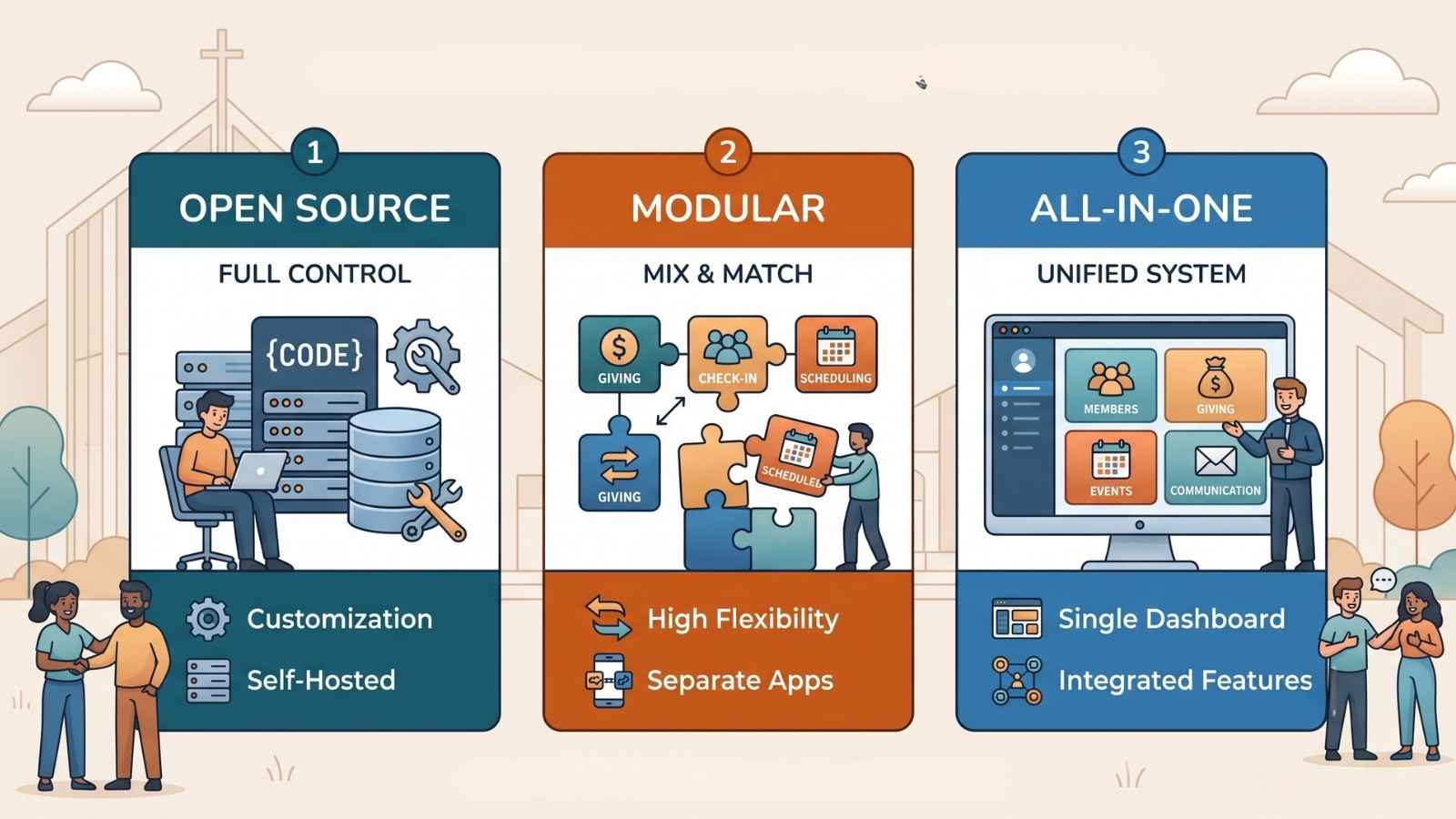
Choosing the right church software comes down to balancing control, flexibility, and simplicity:
-
Open Source: Gives you complete control and customization over your database for free, but it requires dedicated technical expertise to host, secure, and maintain.
-
Modular: Lets you mix and match the best individual tools on the market (e.g., separate apps for giving, youth ministry, and email marketing) and link them together, offering high flexibility but higher cumulative costs.
-
All-In-One: Bundle every tool you need into a single dashboard under one subscription, making it the easiest option to manage but occasionally sacrificing deep features in specific areas.
Ownership and Support: Why We Omitted Popular Platforms
When evaluating church software, there are two important details that don't show up on the review sites: Who owns the company, and who helps when things break?
- Company ownership: Platforms like Tithe.ly and ACS Technologies are owned by investors. Typically, when a company answers to investors instead of ministries, your subscription fees go toward corporate growth targets rather than product updates.
- The Support Problem: Other affordable options, like ChMeetings, often utilize global or outsourced support and development networks to keep their software pricing low.
Behind the Picks: The 2026 Evaluation Framework
We didn't just pull these three names out of a hat. To find the church software options genuinely worth a ministry's time and budget in 2026, we filtered the market through four strict operational pillars:
- Core System Density: Does the platform cover the foundational operational needs — member database, communication, and finance, all without requiring a dozen third-party integrations?
- The Volunteer Friction Test: Can an elderly volunteer or a busy parent learn something like the check-in or attendance system in under 10 minutes on a Sunday morning?
- Budget Predictability: Is the pricing tier transparent and based on simple metrics (like church size), or are there hidden fees and paywalled features that punish a church for growing?
- Sovereignty & Alignment: Is the company structure built to serve local ministries long-term (private/non-profit), or is it backed by institutional investors focused on maximizing user monetization?
Why You Can't Trust Other Review Sites
If you search for "Best Church Management Software," the top Google results are massive software directory aggregators and blogs filled with affiliate links.
Here is why you should take third-party review rankings and "best of lists" with a grain of salt:
- The Pay-for-Play Bidding Model: The default sorting on major review sites isn't "Best Quality", it's "Sponsored." Software companies can literally bid on their position. A platform with lower ratings can outrank a superior product simply because they pay a higher fee per click.
- Incentivized (Bribed) Reviews: Most of the 5-star reviews you see on aggregator sites are the result of aggressive gift-card campaigns. Companies routinely offer $20 Amazon gift cards to users in exchange for a review. You aren't reading organic enthusiasm; you're reading incentivized data.
- The Affiliate Bias: Many independent "Review Blogs" or "Tech Pastors" are heavily funded by affiliate commissions. They will naturally rank platforms that offer a 20% recurring monthly payout over superior, affordable platforms that don't offer kickbacks.
Disclaimer: All product names, logos, and brands are property of their respective owners. Pricing data was verified as accurate at the time of publication.



Best Church Software FAQs
When private equity firms or venture capitalists acquire a church software company, their primary goal shifts from serving ministries to hitting aggressive investor growth metrics. This corporate transition almost always results in immediate price hikes, stripped-down development, and outsourced or automated customer support.
While the source code itself is free to download, Rock RMS requests a voluntary annual donation of $4.45 per weekly attendee.
Yes. Unlike most church management systems that require a third-party integration, ChurchTrac offers a native, fund-accounting module built specifically for ministries.
Major software directories use a pay-for-play bidding model where companies can buy the top "Sponsored" slots regardless of ratings. Many of the five-star reviews on those platforms are incentivized through gift-card campaigns, and independent tech blogs frequently rank options based on high affiliate payouts rather than software quality.
Modular platforms (like Planning Center) let you purchase independent apps for specific ministries, which offers premium customization but can lead to high monthly costs. All-in-one platforms (like ChurchTrac) bundle your database, accounting, website, and scheduling into a single subscription.