The Role of a Church Treasurer: Duties and Responsibilities

- The role includes record keeping, budgeting, reporting, and compliance.
- Clear processes and accountability are essential to avoid errors and burnout.

Your church’s finances fuel its ministry.
From paying staff to supporting missions, every dollar matters—and someone needs to steward it well. That’s where the church treasurer comes in.
While every church is different, this guide breaks down the core responsibilities, tasks, and expectations most churches should have for this critical role.
Church Treasurer Duties and Responsibilities
The financial secretary is entrusted with the stewardship of your church's resources to advance the mission and vision of your church. This role goes beyond mere bookkeeping; it encompasses the responsibility to uphold transparency, accountability, and integrity.
Churches cannot afford to take this role for granted! It's important to have their responsibilities laid out clearly for everyone to see so that nothing gets overlooked.
So check out the overview of church treasurer responsibilities below, then keep reading for when these tasks need to be completed:
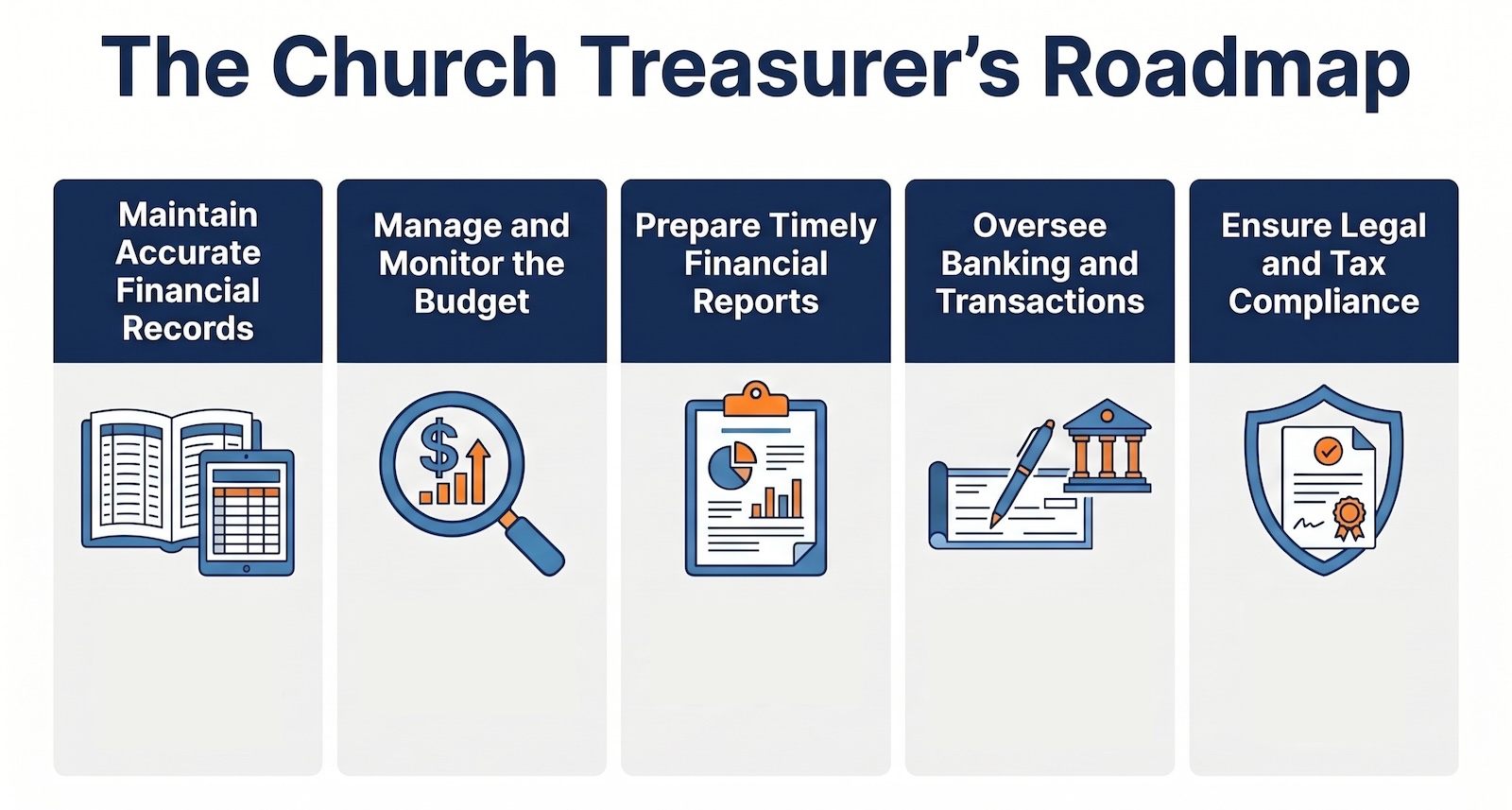
Accurate Record Keeping
Keeping accurate financial records is paramount to the church's financial management. It's the main purpose of the role of church treasurer!
The church treasurer is responsible for recording all income, expenses, and donations meticulously. These records not only facilitate budgeting and financial reporting but also ensure compliance with legal and regulatory requirements.
Budget Management
A church's budget is a reflection of its priorities and mission.
The treasurer monitors the budget, ensuring that the church is raising enough money and isn't overspending in alignment with the church's goals. They also need to produce monthly, quarterly, and annual budget reports and coordinate the creation of the budget each year.
Since we've mentioned reporting twice...
Financial Reporting
Creating detailed, concise, easy-to-understand financial reports is the #1 way to maintain transparency and accountability.
Transparency is the cornerstone of effective financial management for a church. The treasurer is responsible for providing regular financial reports to the church leadership and congregation.
Banking and Transactions
The treasurer oversees all banking activities, including deposits, withdrawals, and reconciliations. Maintaining robust internal controls and adhering to best practices safeguard the church's financial assets against fraud and mismanagement.
This will require accuracy and attention to detail. Also, having another pair of eyes review the treasurer's work is recommended.
Compliance and Legal Requirements
Churches are subject to various legal and regulatory requirements, including tax laws and reporting obligations. The treasurer must stay abreast of these requirements and ensure compliance to maintain the church's nonprofit status. By adhering to ethical and legal standards, the treasurer upholds the integrity of the church and its mission.
BONUS: Finding New Revenue Opportunities
Yes, a church treasurer can help with fundraising!
One underrated way a church accountant can serve the church is by researching and brainstorming new revenue sources.
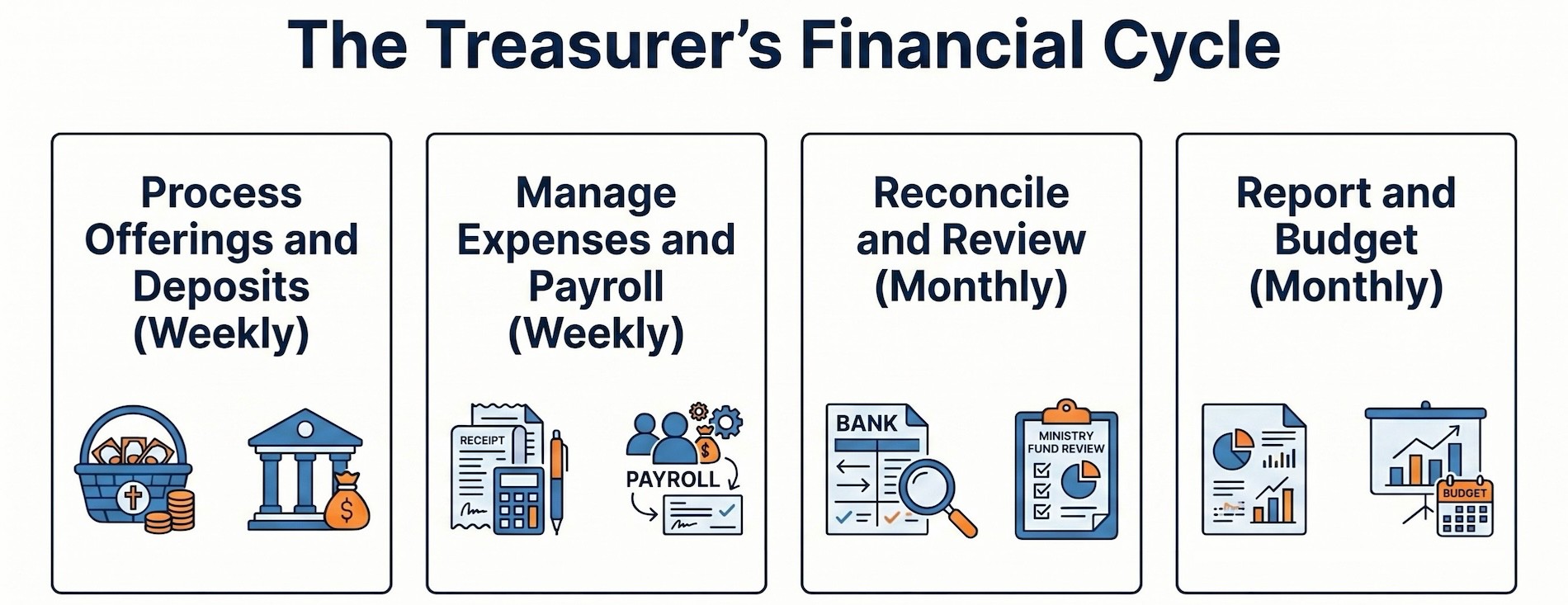
Weekly, Monthly Church Treasurer Tasks
Now that we've laid out the most important responsibilities for the treasurer, let's cover when these tasks need to be handled.
Weekly Church Treasurer Tasks
- Count the offerings and record the donations
- Deposit donations in the church bank account
- Gather receipts and record expenses
- Pay employees
- Update church budget
- Prepare financial reports
Monthly Church Treasurer Tasks
- Reconcile bank accounts
- Attend monthly administration meetings and submit monthly financial reports
- Budget performance review
- Review each ministry fund
- Pay monthly expenses
- Pay employees and record payroll
Quarterly and Annual Treasurer Roles
Some tasks only come once a quarter, biannually, or annually. When the treasurer is to do these tasks is up to the church.
- Prepare and present quarterly financial reports to the congregation
- Budget analysis and reports
- Annual budget review and preparation
- Annual employment tax filings
- Providing tax statements and contribution statements to all donors
Set Your Finance Secretary Up for Success
Don't take your church finances for granted!
Share your expectations and needs with your church treasurer so that your church's finances are managed properly. This will give you the peace of mind you need to focus on your ministry.
Financial Disclaimer: This article is provided for informational purposes only and does not constitute professional accounting, tax, or financial advice. Church tax laws are complex and subject to change based on federal, state, and denominational regulations. ChurchTrac is a software provider, not a CPA firm. We strongly recommend consulting with a qualified tax professional or certified public accountant before making financial decisions or filing tax-related documents for your ministry.



FAQs: Role of Church Treasurer
A church treasurer does not need to be a professional accountant, but they should be trustworthy, detail-oriented, and willing to learn. Familiarity with basic bookkeeping principles, spreadsheets, or accounting software is helpful. Most importantly, the treasurer should understand that their role is a ministry of stewardship, not just a financial task.
Even the most reliable treasurer should not operate in isolation. Best practice includes regular financial reporting, dual controls for handling funds, and periodic reviews by church leadership or a finance team. Oversight protects both the church and the treasurer.
In many churches, the treasurer role is volunteer-based, especially in smaller congregations. As financial complexity increases, some churches move toward stipends, part-time roles, or shared financial responsibilities. The decision should be based on workload, risk, and the church’s ability to support the role well. So, depending on your situation, a church treasurer may be a paid position.
Common issues include unclear expectations, lack of documentation, relying on one person for all financial tasks, and using tools that don’t scale as the church grows. These problems often lead to burnout or errors rather than intentional wrongdoing.
Churches can support treasurers by providing clear processes, reasonable expectations, training resources, and tools that simplify day-to-day work. Regular encouragement and transparency from leadership also go a long way in preventing fatigue and turnover.
If financial reporting is consistently late, confusing, or stressful—or if the treasurer feels overwhelmed—it may be time to reevaluate systems and workflows. Growth in giving, staff, or ministries often signals the need for more structured financial management.