Zelle for Churches: The Ugly Truth


In the past, we've encouraged churches to use Zelle for its benefits. But at this time, we can't recommend that churches use Zelle's platform for accepting donations online.
Zelle works well for paying back a friend. It wasn't built for church giving, though, and the protections many people assume they have often don't cover the issues churches face most. Here's what to know, and what to do if your church already uses it.
Why Churches Like Zelle
Churches like Zelle for ONE BIG REASON: it doesn't charge fees. Every church wants to keep the cost of online giving low, and with Zelle, the banks cover the cost (for now), so you keep 100% of what's given. Many members also already have Zelle in their banking app, and the money arrives quickly.
Those are real benefits. But they come with risks worth weighing before you put Zelle as a forerunner for accepting tithes and donations.
The Scam Risk to Your Members
Federal law gives people some protection when money leaves their bank account electronically. Under a rule called Regulation E, if someone sends a Zelle payment from your account without your permission (for example, after stealing your phone or getting into your banking app), your bank has to investigate and generally reimburse you, as long as you report it quickly.
But that protection has gaps that matter for churches.
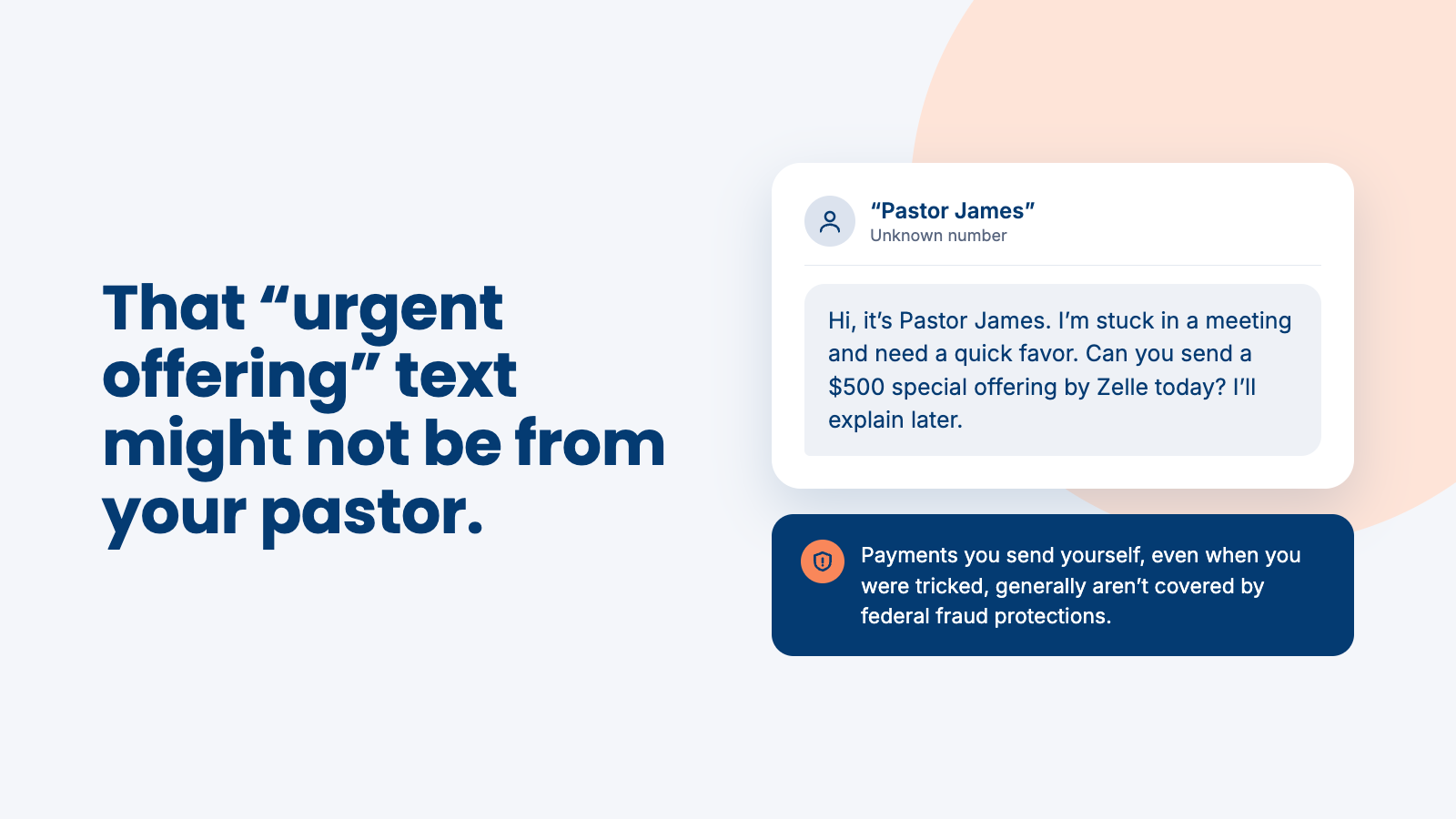
It doesn't cover payments you send yourself, even if you were tricked. Scammers often impersonate pastors, texting members to ask for an urgent donation or "special offering." If a member sends that money through Zelle, the law generally treats it as a payment they authorized. Zelle's network reimburses some imposter scams, but coverage depends on the bank and the situation, and once money is sent it usually can't be pulled back.
Regulators have taken notice too. In August 2025, New York's attorney general sued Early Warning Services, the company that operates Zelle, alleging that weak safeguards let scammers take more than $1 billion from users between 2017 and 2023. In July 2026, a judge allowed the case to move forward; Zelle denies the claims and has said it will appeal.
No matter how the case ends, scammers aren’t waiting for a verdict, and neither should your church.
The Risk to Your Church's Own Account
Regulation E is built for personal accounts. It applies to consumer accounts. A church's bank account is usually an organizational account, so if money goes missing from it, you're generally relying on your bank's own policies rather than these federal protections.
That makes it worth asking your bank directly: what happens if someone gets into our account and sends money out through Zelle?
Zelle Isn't Designed for Church Giving
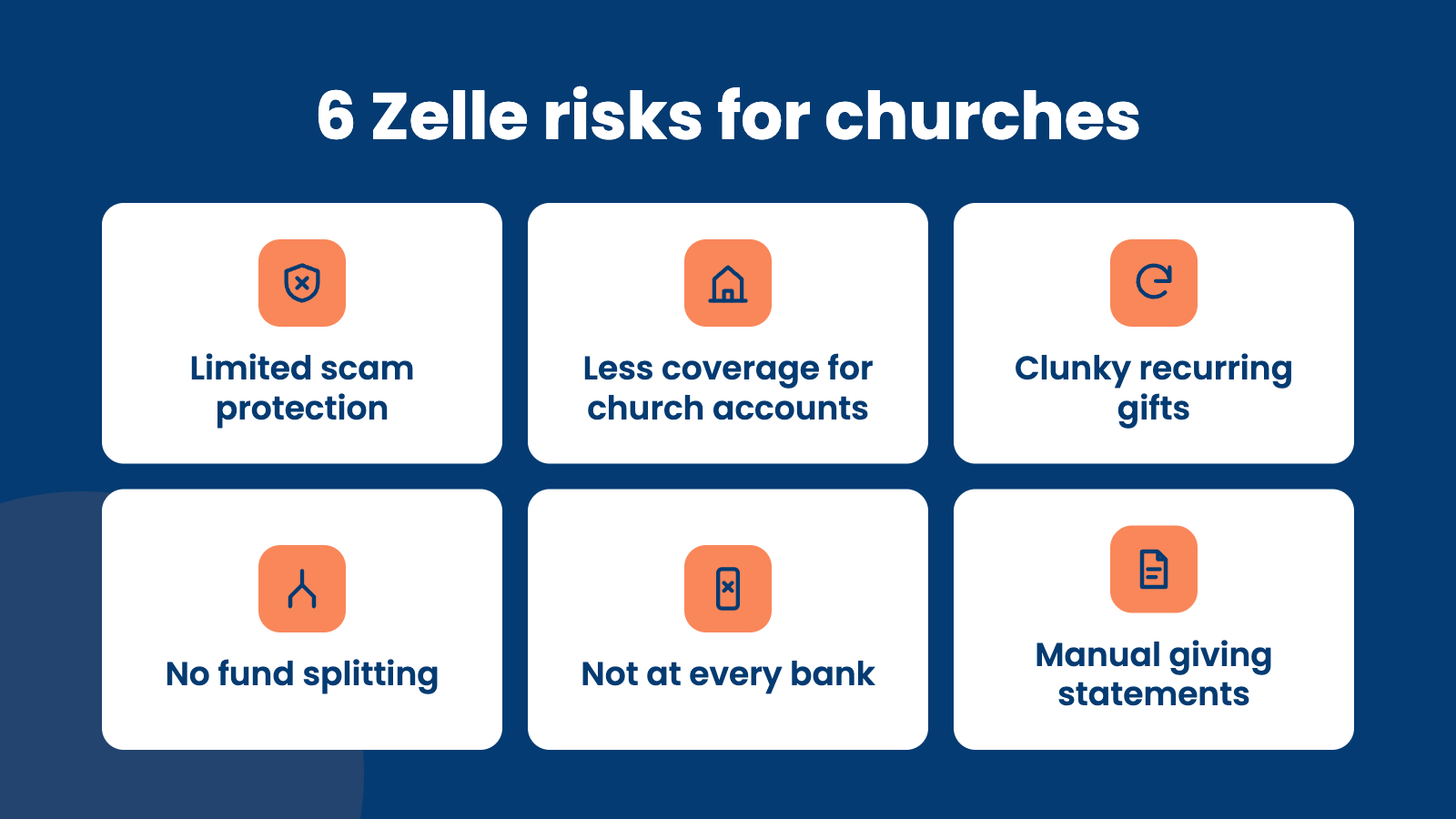
Even setting fraud aside, Zelle misses many of the features ministries need. Here's what church leaders have told us:
- Recurring payments are difficult to set up or edit by the less tech-savvy members.
- It works differently in every banking app, making it hard to guide members on how to use it.
- Splitting a contribution into more than one fund in one payment is not possible.
- Many members can't use it at all. Zelle is available through many large banks, but not at many small banks and credit unions. Zelle no longer offers a standalone app, so members whose bank doesn't participate simply can't use it to give.
- The email addresses for Zelle donations are not always the email addresses churches have on file.
- Giving statements become manual work. With limited donor information, someone has to match each payment to the right person and fund by hand.
If Your Church Already Uses Zelle
Switching platforms takes time. In the meantime, a few steps can lower your risk:
- Tell your congregation how you will and won't ask for money. Say from the pulpit, in your newsletter, and from the rooftops that church leaders will never ask for special offerings, gift cards, or payments by text or email!
- Use a separate account. Receive Zelle donations into an account that holds only what you need, and sweep funds to your main account regularly.
- Lower your limits and turn on alerts. Ask your bank to set the lowest practical sending limit on the account and to alert you to every transaction.
- Require two people for outgoing payments. Use your bank's dual-approval feature if it has one.
- Reconcile weekly. Match every Zelle gift to a donor and fund promptly, so giving statements are accurate and anything odd is caught early.
- Know who to call. Keep your bank's fraud line handy and report anything suspicious the same day.
Zelle Alternatives for Church Giving
This is so important that we devoted an entire hour to discussing the hundreds of online giving platforms and how to choose the right one for your church. And of course, we covered Zelle! Watch the video below to learn more:
For most church leaders, the easiest option is the giving built into the church management software they already have. Most church management software companies partner with online giving providers, and this approach is often the most cost-effective and easiest to manage as your church grows.
ChurchTrac integrates with Stripe for Online Giving. Stripe boasts industry-leading fraud protection (and very low transaction fees). That means you and your members can trust Stripe to be safe and secure.
Should Churches Use Zelle?
Zelle is free and familiar, but it isn't the best fit for tithes and donations. Members have limited protection, and it lacks vital features that churches need for their regular tithes and donations.
If your church uses Zelle today, take the steps above to lower your risk. And when you're ready to switch, choose a giving platform built for churches and one that protects your members.
Zelle FAQs
Can a church use Zelle for donations?
Yes. Churches can use Zelle, Cash App, Venmo, and other peer-to-peer payment apps for donations. But these platforms aren't designed for nonprofits, and they can expose churches and members to risks covered above.
Does Zelle charge a fee for donations?
No. That's the main reason churches like it: it lets them avoid transaction fees. But the savings come with trade-offs in fraud risk and missing features, so weigh both before you decide.
Does Zelle report church donations to the IRS?
No. Zelle doesn't issue Form 1099-K, because money moves directly between bank accounts. (For other payment apps, the federal 1099-K threshold is back to $20,000 and 200 transactions after Congress repealed the $600 rule in 2025. Some states set lower thresholds.)
The bigger issue for churches is record-keeping. Zelle gives you limited donor information, so you'll need to match each payment to the right person and fund by hand to send accurate giving statements, including the written acknowledgments donors need for gifts of $250 or more.
Will Zelle refund money if scammed?
It depends on what happened. If someone sent money from your account without your permission, federal law generally requires your bank to investigate and reimburse you if you report it promptly. If you were tricked into sending the money yourself, a refund isn't guaranteed. Some imposter scams are reimbursed, but many aren't. Church accounts generally don't get the same federal protections as personal accounts.